
avatarharuki zaemon

Has Cynicism Infected Your Organization?

Shared by

(via Warren)

Don’t presume that someone we perceive as cynical is inherently so:

Workplace cynicism isn’t due to some sort of character flaw or being a “glass-half-empty” person. It originates from the workplace environment, not the individual. Many experts, in fact, see workplace cynicism and depersonalization as a form of defensive coping: Becoming distant and withdrawn is a self-protective measure that places a buffer between an employee and the emotional exhaustion and energy depletion their job is causing. Even relentless optimists’ protective measures can be broken down when they’re exposed to high degrees of stress, especially when that stress continues unabated.

Along with “energy depletion or exhaustion,” and “the feeling that you’re no longer able to perform at your best,” cynicism towards your job is considered one of the three core attributes of burnout:

Workplace cynicism, may be the least-understood aspect of burnout in part because of its complexity. In contrast to exhaustion and diminished efficacy, whose causes and effects are relatively straightforward, cynicism can be caused by a number of workplace factors, and it can be expressed in a broad range of emotional states and behaviors.

Even though cynicism can spread quickly between people and teams, there are things we can do to prevent it infecting the organisation:

  • Have the self-awareness to monitor [your] own emotions and behaviors, and the self-regulation to project the positive emotions and behaviors [you]’d like to see in others.
  • Explore what’s driving this behavior [in others] — deep, empathetic listening can often assuage cynical feelings.
  • Create an environment of empathy at work by getting to know your employees, welcoming their perspectives, and listening to their input. Don’t ignore or put off their concerns — act on them.
  • Promote an environment of psychological safety where employees feel free to speak honestly about their feelings and ideas and to make mistakes without fear of shame or repercussion.
  • No one likes to feel left in the dark, especially when it comes to decisions that affect them, so share impactful decisions with employees and maintain open lines of communication.
  • Where possible, offer flexible work schedules and arrangements. Encourage employees to contribute ideas and help set direction, and give them ownership over their deliverables.
  • Make sure your mission as well as your team and individual mandates are clear and achievable, and let employees know what they can expect from you, too.

We can even use the idea that cynicism is an “emotional contagion” against it:

One of the best things about emotional contagion is that it works both ways, so it’s just as easy to spread feelings of empathy, trust, appreciation, and genuine idealism.

As an aside, I think we can fall into the trap of labelling worry, anxiety, and the act of tackling reality head on as cynicism, when sometimes it might be poor communication skills. The Oxford Dictionary of English defines cynicism as:

cynicism | ˈsɪnɪsɪz(ə)m | noun [mass noun]

  • an inclination to believe that people are motivated purely by self-interest; scepticism.
  • an inclination to question whether something will happen or whether it is worthwhile; pessimism.
What the Apple Watch Ultra taught me about multiband GPS and failure - The Verge

Shared by

(via Ron Jeffries)

I almost quit this year’s New York City Half Marathon. I’d been running for nearly two hours in freezing temperatures, straight into the wind. All I wanted was to beat last year’s time, even by just one millisecond. If it weren’t for a well-timed cheer from a friend around mile 10, I probably would’ve called it a day.

[…]

All I wanted from this year’s NYC Half was to run it faster than last year. I wanted that because, last year, I ran the race — my first half-marathon — as part of Team ALS. I joined on a whim mere weeks after my mom died from the incurable disease. It felt like rebellion after a year defined by ALS.

[…]

I’ve come to accept that, at the heart of it, I didn’t really want to do better this year. For all the impressive tech it [the Apple Watch Ultra] packs in its titanium case, it cannot measure grief. Mental health is also health, and as they say, the body keeps the score. It just so happens that the mental side of the equation is much harder for wearables to meaningfully quantify.

[…]

All that’s left is to take these lessons and apply them going forward. I’ve already signed up for my next race. I will 1,000 percent be testing no less than four devices — including the Ultra — while training. But for once, I have no time goal. I’m trying not to make a narrative of the data. I think I’ll simply run and see what that feels like.

Extract the kernel | Irrational Exuberance

Shared by

Will Larson:

The most frequent issue I see is when a literal communicator insists on engaging in the details with a less literal executive. I call the remedy, “extracting the kernel.”

[…]

The CTO’s point is almost always not about [the specific details]. Instead, their point is that [e.g.] the timeline feels too slow. If the team anchors on responding to the specific suggestion, they’ll miss the more important discussion entirely. Even if they convince the CTO that [their idea] is the better choice, the CTO will be annoyed that their real concern about the schedule wasn’t addressed.

[…]

You’ll make much more progress by focusing on improving how you communicate with them than by blaming them for their deficiencies.

[…]

When you get a question from an executive, focus on understanding the insight or perspective within the question. Then confirm that insight with the executive explicitly.

[…]

Ensure that the CTO’s feedback is addressed rather than getting caught up on the incidental details in their question.

Responsibility laundering

Shared by

Another great term I hadn’t heard of before, via the always interesting FLUX Review, Ep. 101:

What can organizations do in the face of challenging decisions, especially when the result may be unpleasant or unpopular? One popular approach is to insert a mechanism that makes the decision for them. This responsibility laundering is an abstraction layer that shifts the perceived responsibility for the decision from a person to a process.

Responsibility laundering is not always a bad thing: it can reduce some kinds of biases. Without it, decisions are likely to devolve into mere patronage.

Some examples of responsibility laundering include:

  • Data-driven decision making.
  • Committee-driven promotion and hiring decisions.
  • Formula-driven compensation.
  • Feedback surveys.
  • Goal setting processes such as OKRs.

[…]

One telltale sign [we’re not using it properly] is when responsibility laundering is used to wash our hands of the consequences: “I regret this outcome, but we followed the process…”

Look out for bias hidden within the process. If we are not examining the process critically, we might not notice when things are just a bit off.

[…]

  • Ask when responsibility laundering is the right choice.
  • Monitor the outcomes for signs of bias.
  • Make it possible (and preferably easy) to switch or remove these processes.
  • Take responsibility for the decisions that ultimately get made.

7 Ways to Meet the Need to Feel Seen, Heard, and Understood - Leadership Freak

Shared by

For me at least, a timely reminder with helpful examples.

Observations:

  • You feel motivated when you feel seen.
  • You tend to disengage when you feel unheard.
  • You’re anxious or angry when you feel misunderstood.
  • You engage when you feel you matter.

Advice:

  • Practice vulnerability. Declare development goals.
  • Discuss progress. Let people know how you’re doing.
  • Provide clear expectations.
  • Recognize strengths publicly. Everyone on the team needs to know the top five strengths of everyone on the team.
  • Learn to listen. You can listen without committing to do everything people say.
  • Thank people for contributing.
  • Accept the human condition. Everyone has weaknesses, even you.
  • Practice empathy.
  • Affirm people’s energy.

Principles of economics, translated

Shared by

I watched this for the first time 15 years ago and it still makes me laugh:

Micro-economists are people who are wrong about specific things; and Macro-economists are wrong about things in general.

It came to mind again today in a discussion with our Senior Principal Engineer (who as it happens has a degree in Economics) on decision paralysis.

I think at times the drive to work on “the most valuable thing” leads to choosing between things of marginal difference, or between a set of options that are all necessary to derive the desired outcome:

the worst possible situation in fact would be someone offering you a choice between a Snickers bar, and an identical Snickers bar.

Now, people not trained in Economics might think that that’s no different from being offered one Snickers bar, but that sort of sloppy thinking will never get you a tenure-track position.

How to be a great leader? Don't make decisions for others - ColoradoBiz Magazine

Shared by

The instinct to manage people causes us to solve their problems and make decisions for them. Blakeman urges us to instead:

train others to solve and decide, and then get out of the way. Leaders who figure out they shouldn’t make decisions can lead wildly successful companies devoid of command-and-control management.

When we make decisions for others long enough, we eventually erode their sense of purpose, agency, and motivation:

Ownership is the most powerful motivator in business, and the ability to make decisions is at the core of ownership. Stop solving and deciding for others. They are adults. They can do it themselves, and better than you could. Instead, ask questions, train others to make great decisions, and then get out of the way and let them do it.

We all need to make decisions; we don’t need to make all the decisions:

The art of leadership is to know how few decisions the leader needs to make.

Give people their brains back. Stop managing (making decisions). Start leading.

Alignment gets expensive. Don’t skimp on it. – Jessitron

Shared by

(via Ray Grasso)

In a recent post I talked about my personal experience with the effort and discomfort required to lead people and teams. Creating alignment can feel inefficient.

I especially appreciate Jessica’s distinction between alignment and collaboration. I value collaboration over (not instead of) individual contribution, and the nuance here is not that collaboration is bad, rather “We can’t collaborate with everyone, so it’s alignment that can give us the trigger and authority to communicate when we need to.”

Jessica Kerr:

How can we do our work well, together, as we get bigger?

  1. Accept coordination overhead. Document shared plans in a shared place (we use Asana). Coordination is for asynchronous work, and we can do a lot of the coordination asynchronously too.
  2. Collaboration is expensive. Replace it with coordination when you can, by decoupling. When you need collaboration, go all in. Get people in the same room if that’s a thing, or talking every day in Slack & Zoom. Build relationships to make communication smooth. Read Team Topologies.
  3. Do not skimp on alignment.

Alignment is not expensive, compared to collaboration. But it feels disposable, it’s easy to let slip. Alignment comes from leadership in our all-hands and all-teams meetings. It comes in 1:1s with our managers, and between our managers. It comes in documented company values and positions.

Alignment gives us the context to make good decisions in our scope. It also lets us question decisions outside our scope, constructively, because we can notice when we learn something inconsistent with our expectations. That catches discrepancies early, and gets us back on track together.

In a small enough company, alignment is mostly free. It happens in conversation, and via collaboration. As our company grows, our founders are more and more deliberate about reproducing it.

Texas A&M Professor Wrongly Accuses Class of Cheating With ChatGPT – Rolling Stone

Shared by

(via The Sizzle)

Texas A&M University–Commerce seniors who have already graduated were denied their diplomas because of an instructor who incorrectly used AI software to detect cheating.

Texas A&M University-Commerce said they were investigating the incident and developing policies related to AI in the classroom. The university denied that anyone had received a failing grade.

I can’t wait to never find out about all the other stuff that’s going on that negatively impact our lives.

(p.s. go subscribe to The Sizzle)

The Future of the Data Engineer. Is the data engineer still the "worst"

Shared by

A few years ago, we had our first go at developing a concrete Data Engineering strategy.

This article I read this morning was validating as it touches on many of the challenges we identified and tried to address as part of our Data “Playbook”:

  • Data engineers operate on a myriad fronts and to any one partner or stakeholder, it can seem like people are always working on other things.
  • The Data Warehouse reflects the organisation. Chaos in, chaos out. Lack of consensus in, lack of consensus out.
  • Data as a product, explicit and distributed governance and use of data, and modern tooling.
  • Move away from just getting things done, to more traditional Engineering practices. That takes time.

Some of the data engineer’s biggest challenges: the job was hard, the respect was minimal, and the connection between their work and the actual insights generated were obvious but rarely recognized. Being a data engineer was a thankless but increasingly important job, with teams straddling between building infrastructure, running jobs, and fielding ad-hoc requests from the analytics and BI teams. As a result, being a data engineer was both a blessing and a curse. In fact, in Maxime’s opinion, the data engineer was the “worst seat at the table.”

[…]

It’s widely accepted that governance is distributed. Every team has their own analytic domain they own, forcing decentralized team structures around broadly standardized definitions of what “good” data looks like.

[…]

The data warehouse is the mirror of the organization in many ways. If people don’t agree on what they call things in the data warehouse or what the definition of a metric is, then this lack of consensus will be reflected downstream.

[…]

It’s not necessarily the sole responsibility of the data team to find consensus for the business, particularly if the data is being used across the company in different ways.

[…]

Nowadays, data teams are increasingly relying on DevOps and software engineering best practices to build stronger tooling and cultures that prioritize communication and data reliability.

[…]

While data team reporting structure and operational hierarchy is becoming more and more vertical, the scope of the data engineer is becoming increasingly horizontal and focused on performance and reliability — which is ultimately a good thing.

[…]

With the rise of these new technologies and workflows, engineers also have a fantastic opportunity to own the movement towards treating data like a product.

Open and Closed, Omission and Collapse

Shared by

Friday afternoon, and my efforts to get to inbox zero are being hampered by people sending me emails.

Which reminded me of this I read yesterday:

Workload generators may be classified as based on a closed system model, where new job arrivals are only triggered by job completions (followed by think time), or an open system model, where new jobs arrive independently of job completions. In general, system designers pay little attention to whether a workload generator is closed or open.

How to Motivate Employees When Their Priorities Have Changed

Shared by

The article centres on the push to get people back into an office, but I think the general themes are more broadly applicable:

Get into a conversation with a company leader these days, and you’ll likely hear some version of “no one wants to work hard anymore.” I see my C-suite clients grasping for more control to get back to “normal” by pushing for longer hours in the office, tightening metrics, and hoping that economic headwinds will return their power.

[…]

Inspired people make inspired workers make inspired companies. Is it better to have a productive worker who leaves early to train for a marathon or a burned-out worker who’s strapped to their desk? How do you judge the person who declines a promotion because they love their job exactly as it is? Let’s not punish people who have an updated model of success that works for them.

[…]

For most of us coming up, there was a predictable cadence to professional work. You grind it out early, give up large parts of your life, and eventually gain some control over your time. Yes, you had to do it, but was it really the best way to get the best work? I know when I was working seven days a week until 11 P.M., I was not a fount of creativity. Every new shift in work necessitates an end to an existing norm. Instead of bringing people down to your experience, consider how you can bring everyone up to a new one.

[…]

People wasted a lot of time in the office right under your nose, and if they want to waste time, they’ll do it anywhere. You’re far better off measuring performance and losing the fixation with time. The more latitude managers can give in creating the right working environment for the individual, the less guilty everyone will feel and, thus, the more they can focus on doing good work.

[…]

When we sense control slipping, we tend to want to micromanage people and processes. Recessionary pressures exacerbate this effect. Fear has never been an effective motivator over the long term. Worrying about job preservation causes people to hunker down, not take risks toward excellence.

Product Vision is Science Fiction

Shared by

If you’ve ever tried coming up with a vision, you know how hard it can be:

Product vision isn’t setting revenue targets or creating a list of features you wished your product had. Vision is imagining a future world with your product in it and telling a story about how people will experience your product(s) in that future.

[…]

Vision is not a plan; Vision is not a business goal or growth target; Vision is not accurate, feasible, or even possible in the near term.

It’s especially difficult for mature companies looking to figure out what’s next:

A common problem for many companies is that the organization has already achieved the vision that motivated the founder. That founder may not even be with the organization anymore. That company today may be searching for a vision – searching for its place in the future. In the meantime, vison gets replaced by revenue and growth targets. That’s not so inspiring and motivating.

When Development Works and When to Let them Go - Leadership Freak

Shared by

I’m a big believer in deliberate development. I still don’t get the balance right and can wait too long, or sometimes not long enough before I realise someone needs explicit coaching:

Big hearted leaders tend to wait too long and stress too much over poor performers. Kindness makes you beautiful. Enabling incompetence in others is destructive.

Employees Are Losing Patience with Change Initiatives

Shared by

This is something I’ve been hearing more from folks across multiple companies:

Relentless sprinting means many employees are running on fumes.

The most common mistake when it comes to change management today is trying to build momentum for transformation by hitting the accelerator. A 2022 Gartner survey found that 75% of organizations are adopting a top-down approach to change, where leaders set the change strategy, create detailed implementation roadmaps, and deploy a high volume of change communications. Their goal is for workers to buy into the new path and for managers to lead the charge as champions and role models for their teams.

[…]

Prioritized change means leaders show employees where to invest their energy by communicating their backlog of priorities, including change initiatives. Without such guidance, employees are likely to give 110% for each change, resulting in a blowout.

[…]

Many leadership teams already rank the most important organizational projects and initiatives, but that knowledge often isn’t shared beyond leadership team discussions. Communicating this more broadly can help teams more effectively manage their energy and efforts.

Schelling traps

Shared by

I had not heard of the term until today—which seems extraordinary given a large part of my career has been dealing with the kinds of problems caused by exactly this. It’s incentives; always incentives!

The FLUX Review, Ep. 96:

Schelling points are the default solutions that people arrive at if they can’t communicate. The prisoner’s dilemma is an example of a Schelling trap, where the lack of communication means that individuals are incentivized to betray each other even though they’d be better off if they both stayed silent.

Breaking free requires a mutual and simultaneous deviation from the status quo. If we break out but others do not, then we’ll be less effective than they are.

As the size of an organization grows and its structure becomes more complicated, the complexity of communication, coordination, and incentives increases. This leads to the emergence of whatever default is expedient.

a company that maintains redundant, uncommunicative, and siloed departments working on similar projects. Each department thinks their work is unique and vital. They are unaware of the duplicative or misaligned work from the other departments.

Breaking free from this Schelling trap requires a coordinated effort from higher-level management. However, higher-level management may itself be caught in its own Schelling traps, leaving the organization unresponsive to the inefficiency.

It’s tempting to believe that at a sufficiently senior level of management these problems can be easily solved.

Intentional farming

Shared by

The FLUX Review, Ep. 97:

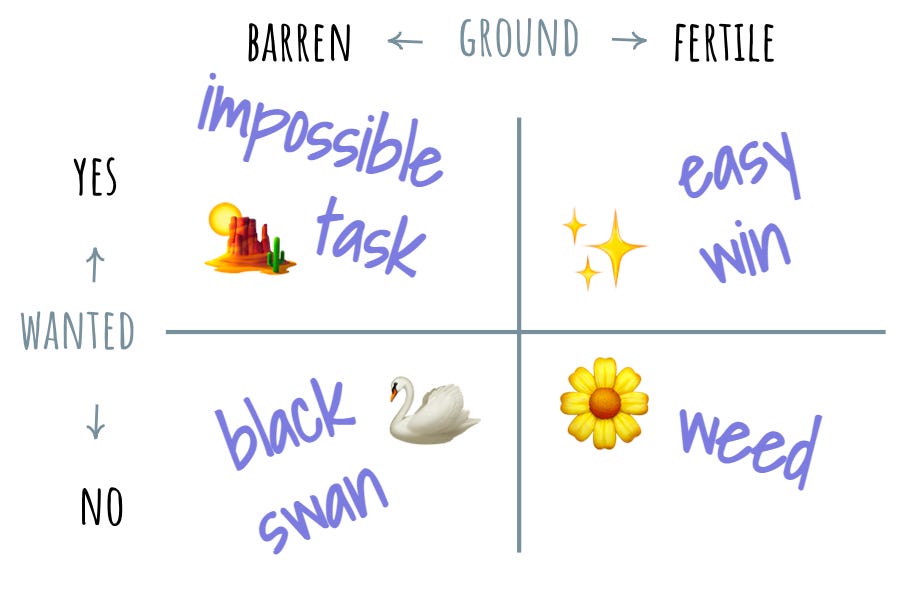
Oftentimes, when we look at a successful or failed project, we tend to look for internal factors to explain the outcome. We assume it is the fault of the seed if it didn’t sprout. We decide that undesirable outcomes come from bad ideas. However, what this lens teaches us is that success or failure is more nuanced. An offhand comment from an executive can lead to an unintentional and unwanted project — a weed. A good idea that fails to thrive might have been planted in the barren soil of an org whose incentive structure doesn’t meet the project’s needs.

Monoliths are not dinosaurs | All Things Distributed

Shared by

Amazon Prime Video rearchitected their streaming service from a distributed microservices architecture to a monolith application, resulting in higher scale, resilience, and reduced costs.

Werner Vogels:

My rule of thumb has been that with every order of magnitude of growth you should revisit your architecture, and determine whether it can still support the next order level of growth.

if there are a set of services that always contribute to the response, have the exact same scaling and performance requirements, same security vectors, and most importantly, are managed by a single team, it is a worthwhile effort to see if combining them simplifies your architecture.

Google "We Have No Moat, And Neither Does OpenAI"

Shared by

(via Michael Neale)

A leaked internal document says Google are in a pickle when it comes to AI, and are being “lapped” by public efforts:

Open-source models are faster, more customizable, more private, and pound-for-pound more capable. They are doing things with $100 and 13B params that we struggle with at $10M and 540B. And they are doing so in weeks, not months. This has profound implications for us.

It would seem that Google’s strength—a monolith with access to vast amounts of data and resources—has become it’s weakness:

Part of what makes LoRA so effective is that it’s stackable. This means that as new and better datasets and tasks become available, the model can be cheaply kept up to date, without ever having to pay the cost of a full run.

By contrast, training giant models from scratch not only throws away the pretraining, but also any iterative improvements that have been made on top. In the open source world, it doesn’t take long before these improvements dominate, making a full retrain extremely costly.

Google are also hampered by trying to attack a generic problem, rather than specific use-cases:

LoRA updates are very cheap to produce (~$100) for the most popular model sizes. This means that almost anyone with an idea can generate one and distribute it. Training times under a day are the norm. At that pace, it doesn’t take long before the cumulative effect of all of these fine-tunings overcomes starting off at a size disadvantage.

These models are used and created by people who are deeply immersed in their particular subgenre, lending a depth of knowledge and empathy we cannot hope to match.

Ukraine Is Now Using Steam Decks to Control Machine Gun Turrets

Shared by

(via The FLUX Review, Ep. 98)

One crowdfunding campaign has raised enough money to build remote-operated mounted machine guns that can be controlled with a Steam Deck, a portable gaming computer with joysticks and buttons on the sides (similar to the Nintendo Switch). They’ve given these guns to Ukrainian soldiers, who will be able to swivel the guns around and shoot while not being exposed to gunfire themselves.